“With a storm in the wind, what would you do?”
As I was reading all of my classmates’ blogs from last week, I saw how a lot of them wrote about stuff they adored or were hyper-fixated on. I think I’ll do the same, so… Cabaret (1993), right?

I FREAKING LOVE CABARET AAAAAAAAAAAAAAAAAAAAAAAAAAAAA
I literally start trembling violently whenever somebody brings it up—that’s how down bad I am for this musical. I know somebody reading this may have no idea what I’m talking about, who that man is, why I titled my blog, or what the quote underneath even means. I PROMISEEEEEEEE I’ll get into that. Let me just explain what the musical is about first. (SPOILERS!!!!!!)
Without getting too in-depth, the musical has this beautiful opening where the Emcee, Alan Cumming, welcomes the audience to the KitKat Klub. A nightclub or cabaret, if you will, for people to escape their worries. Hence, “Leave your troubles… outside!” Anyway, we meet the rest of the Emcee’s crew: Rosie, Lulu, Frenchie, Texas, Fritzie, Helga, Bobby, Victor, Hans, Herman, and finally Sally Bowles.
After the opening, we’re introduced to the main protagonist and another supporting character. Cliff Bradshaw, a “starving author” trying to find somewhere to write, and Ernst Ludwig, a man who smuggles valuables from different countries. Ludwig refers Cliff to Fraulein Schnider’s residence to live in exchange for being taught English by Cliff. He agrees, and there a friendship is born.
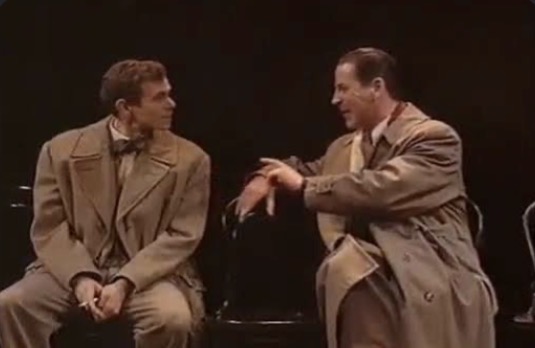
When he gets to Fraulein Schnider, she lends him the room for only 50 marks. Then leaves Cliff by himself to celebrate the New Year with her love interest, Herr Schultz. Did I mention that the year is 1944?
For context, Cliff is in Berlin, Germany during the mid 1940’s. I’m sure you all can put two and two together. So, if learning about the rise of the N*zi Party isn’t your thing, now’s the time to click off this blog, because it only gets worse from here. And honestly, that’s what I love the most about this peculiar musical. It gradually gets worse without the viewer realizing until it’s far too late.
Back to the storyline though, while Cliff is adventuring through the city, he finds the KitKat Klub and meets Sally Bowles. A beautiful young woman who is whoreish, trashy, and uneducated. They hit it off and move in after a few days. During that time, Sally obviously has feelings for Cliff and tries to make advances until she finds out that he’s a homosexual. Even then, Cliff and Sally still stay side by side.
Time passes, and Fräulein Schneider and Herr Schultz are engaged and throwing their party. Everything goes well until Ernst Ludwig arrives. He’s disgusted and disappointed that Fräulein wants to marry a Jewish man, so he walks out, but Cliff grabs his arm before he leaves. There, the N*zi symbol rested on his arm. Cliff is obviously horrified because he read Mein Kampf (My Struggle), a book published by H*tler about his beliefs and plans for New Germany.
To get Ludwig to stay and enjoy the party, a guest sings “Tomorrow Belongs to Me” — a fascist song disguised as patriotism. Apparently, the only people who care are Fräulein Schneider and Cliff, as they watch in terror. In contrast, Herr Schultz and Sally turn their heads to dismiss the Nazis. This scene shows the main characters’ perspectives without overdoing it, and it gets me so misty-eyed.
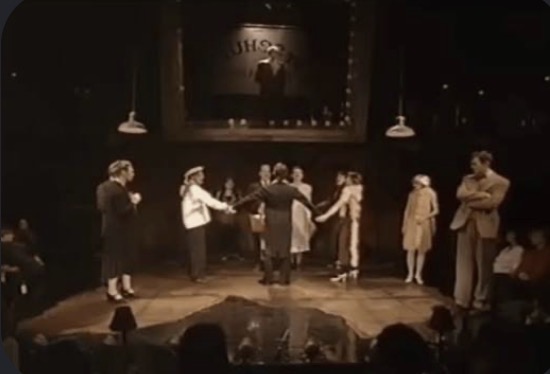
When I say EVERYTHING goes to crap after that scene, I really do mean it. Fräulein Schneider calls off the wedding because she’s stuck in survival mode, and rightfully so. Marrying a Jewish man at that time would mean certain death even though he was literally her soulmate.
On the other hand, Sally Bowles gets pregnant by an unknown man, and when Cliff finds out, he encourages her to keep the baby. He wanted to step up and be the father because he adored the idea of them being a family, so Sally reluctantly agrees. Unfortunately, she couldn’t bear the pregnancy any longer and went behind his back to have an abortion. Cliff was destroyed yet still wanted to be with Sally.
He was already planning on leaving Berlin to flee to the United States and wanted Sally to come with him. She obviously declines, and they fight about what’s going on in the political world with some iconic lines.
“Ugh, you mean POLITICS. What has that got to do with us?” from Sally.
“Sally, don’t you understand? If you’re not against all this, you’re for it… or you might as well be.” and “SALLY WAKE UP! THE PARTY IN BERLIN IS OVER! IT’S BEEN A LOT OF FUN, BUT IT’S OVER NOW!” from Cliff.
He leaves Sally with a train ticket out of Berlin. He advises Sally to use it before walking out — for good. He also urges Fraulein Schneider and Herr Schultz to flee from Berlin too, but they both refuse.
Herr Schultz believes it will “pass over” while Fraulein Schneider claims that she’s in too deep but is resilient and will survive. I got my quote from her song “What would you do?” In my opinion, today’s world is scarily similar to Cabaret. As a teenager, I feel like Cliff and Fraulein Schneider simultaneously — wanting to leave my country because I see dystopian aspects everywhere, but how? I don’t have the money or passport to go somewhere else for a while. I’ll just have to wait it out or defend myself as she implied.
I also got my title from this scene. People often joke about history repeating itself, so I thought it was neat for my title hinting at familiarity.
The story ended as history decided it to — the rise of the N*zi Party and genocide taking full effect. One of my favorite parts about this play is how similar the introduction and ending are, yet the ending is obviously corrupted. The orchestra sounds rough, and the choir has lost its liveliness — almost sounding like shouting soldiers. It’s all so uncanny.
Everyone who stayed in Berlin died. Even the Emcee. We see his final moments — teasing the audience by taking off his trench coat as if he’s naked underneath. When he finally removes it, instead of a nude body, the crowd is met with a much smaller frame dressed in Jewish prisoner attire. He sings “Goodbye. See you soon.” In German, before posing as if he were crucified. The lights cut off, and that was it.
When I first watched Cabaret, I was fifteen years old and extremely confused. I understood some parts of the story, but I still missed so much. The play purposefully blinds its audience with sexuality and gender expression to distract from the actual issue at hand. Cabaret has affected me in many ways — good and bad. I’m more open-minded, compassionate, and likely to speak out in retaliation (curse and blessing).
I’m so glad I get to share my love for this play. It feels like I got my jitteriness all out now. Thank you so much for reading this, and sorry it went on for so long</3333

I can tell you are VERY passionate about cabaret. Makes me want to watch it!
OH MY GOD I LOVE CABARET I LOVE THIS!!!!!!!!! I WAS GONNA WRITE ABOUT IT ONE OF THESE DAYS </3 ITS SUUCH A GOOD MUSICAL THO UGH….i think im gonna write about the 1972 movie because i LOOOOVE that too….
YESYESYES THE 1972 IS SO GOOD AAAAAAAAAAAAAA
DUDE, I LITERALLY WATCHED THIS FOR THE FIRST TIME EVER LIKE 3 DAYS AGO OMG. DUDE, IT’S SO SO SO SO GOOD OMGGG