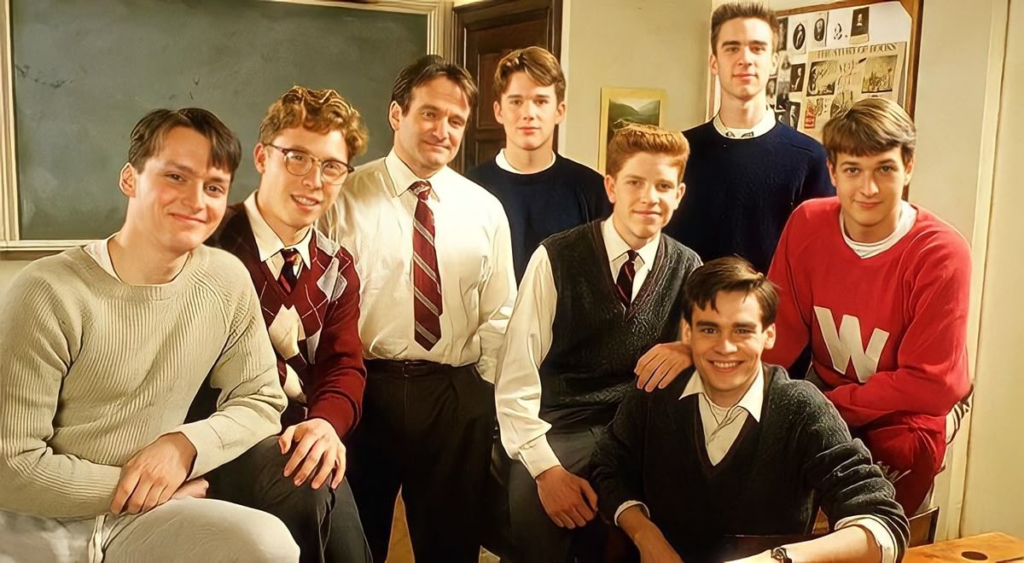
Released in 1989, Dead Poets Society is a cult classic movie about boyhood, creativity, and mental health. The screenplay was written by Tom Schulman and the movie was directed by Peter Weir. The film starred popular actors in their youth, such as Ethan Hawke, Robert Sean Leonard, and the late Robin Williams. There are many topics that the film handles extremely well, which is why it has become such a cult classic and fan favorite through multiple generations. However, there are still many issues with the film that have been ignored and looked over in its popularity. In this blog, I will be discussing the successes and failures of this movie, as well as how I personally would change things up.
For those who may not know, Dead Poets Society is about a group of wealthy, white men who are in their senior year at a prestigious private boarding school. The film also takes place somewhere around 1959-1960, which is another aspect of context that I find particularly important. The film discusses a number of themes, though the central focus is around these young men breaking out of the status quo and seizing the day, so they might seize their whole life.
Many of the main characters feel bound to the expectations of their fathers- other rich white men with successful careers. Multiple characters express the dread they feel, knowing their future had been completely orchestrated by their parents and they’re cursed with following in their father’s footsteps. For characters like Neil Perry (played by Robert Sean Leonard), this expectation is too much. Neil has dreams of pursuing theater and acting, as he has a strong love for the arts. However, Neil’s father forbids this life and expects his son to follow after him.
Neil’s character is a perfect example of the successes of Dead Poets Society. Neil Perry is a creative, light hearted, and extroverted person. He is brave enough to go against his father’s wishes and audition for a local production of Shakespeare’s A Midsummer Night’s Dream. Throughout the movie, Neil is shown to be happy and carefree. He is caring and kind toward his friends, he does well in school, he gets along with others. When he gets to perform in A Midsummer Night’s Dream, Neil is shown to be truly and completely happy. His friends attend the performance and get to enjoy it with him. However, Neil’s father is also there. After the play, Neil’s father takes him home and threatens him with military school. Neil feels stuck. He truly believes that he’ll never be able to live his true self, because of his father. This realization and subsequent dread leads Neil to suicide.
Neil Perry is a uniquely perfect example of what depression and suicidal ideation can look like in people. The movie does an excellent job at showing how free Neil feels on stage and pursuing his love for acting, as well as the horrid contrast of the life his parents have forced upon him. The movie shows what is truly at stake for Neil if he follows after his father. Neil’s rebellion- acting in the play, starting the dead poets society- has true purpose and meaning within the film and his character.
The other characters in Dead Poets Society are not nearly as well rounded. For example, Charlie Dalton is more or less the comedic relief of the movie. He is crude and charismatic. He wants to rebel against his dad and against the higher ups at his school, but he doesn’t truly pursue that rebellion. There is nothing truly revolutionary about Charlie’s beliefs. In fact, he’s pretty racist and misogynistic. He only cares about breaking the status quo when it suits him.
Similarly, Knox Overstreet is another character who falls flat in his revolutionary beliefs. He objectifies women and gropes a girl he allegedly is in love with, while she’s in a relationship with someone else. He also completely abandons his friends to try and pursue a girl who wants nothing to do with him. On top of all of that, he doesn’t seem all too interested in rebelling against the system at all. He is aware of how the world serves him, as he is a wealthy white man, and he’s content with keeping it that way.
There are characters who, while not detrimental in their characteristics, fall flat and could’ve been much more compelling. Stephen Meeks and Gerrad Pitts (I put them together because they are inseparable in the movie and in how they’re written) are both extremely smart and have a lot of opportunities open for them because of that. Pitts talks about possibly going to Yale. He and Meeks engineer an illegal radio so they can listen to music and dance in their free time. They are both supportive of Neil’s dead poets society and avidly participate in meetings. However, we don’t get to know much more about them besides these things. In my opinion, these two could’ve provided a whole different perspective to the revolutionary beliefs shared throughout the movie. The two characters inspired one of my own short stories, specifically the radio that they created and the implications of this creation. I truly feel these two had much more potential, but they were washed to the background by Knox and Charlie.
Similarly, Todd Anderson is a wonderfully written character who struggles with anxiety, family issues, and the expectations of him to become just like his older brother. He also grows extremely close with Neil Perry, to the point there is speculation about the nature of their friendship. The two were extremely close and, after learning about Neil’s death, Todd is lost and distraught. Throughout the movie, we get to see Todd embrace his talent as a poet and become more and more confident in himself. However, we don’t get to know much more about him. To some extent, we only really see him through how he affects others. We see how he cares for and assists Neil Perry. We see how he inspires their teacher, Mr. Keating. We see how the other dead poets society members appreciate him. We don’t get to hear how he feels or what he wants. His character could’ve provided much more to the plot as a whole if we got to hear more from him and his perspective.
While a controversial character, I also feel that Richard Cameron could’ve provided more to the story. I appreciate the inclusion of a character who is anxious or simply against his friend’s desire to rebel and break the rules. I wish there was more to why he feels this way though. He is shown to be a teacher’s pet and a snitch, but we don’t get to know why. I wish we could’ve learned more about him and his motives.
So, how would I change things? For one, I would rewrite Knox and Charlie’s characters in their near entirety. While I completely understand and agree that some characters can and are racist and misogynistic, especially in stories that are meant to mirror the real world. However, I don’t think those characters are needed in this story. In fact, I think they draw away from the entire message and moral of Dead Poets Society. I would add more to the other characters I’ve mentioned and expand more on their beliefs and motives.
Generally, I feel that this movie is missing a lot of motive. Neil is the only character where it’s clear why he wants to rebel and break the rules. He has a true, life or death reason. The other characters sort of just fall in suit behind him, because he’s their friend. I wish we got to learn more about each of the boys, even if it was just small bits of characterization, so we could understand why they want to break the rules. Similarly, they love to complain about becoming doctors and lawyers like their dads, but they never talk about what they really want from life. Neil and Todd are the only ones who seem to know what they want from life. Everyone else just seems angry for no reason, and it makes everything else in the plot seem similarly weak.
On top of all of this, this movie takes place in the late fifties/early sixties and follows a group of privileged white men as they complain about the extremely privileged and fortunate life that they’re being “forced” to live. While I understand the basic idea that’s being conveyed here, I feel like it fails to properly portray it. It’s hard to sympathize with these characters because they have it so good, yet that’s not good enough for them. Again, this would feel a lot different if we got to know more about them and got to understand what exactly they’re missing out on in life. But we don’t. So it all just feels … meh.
Anyways, I haven’t watched this movie in a couple years. I used to watch it all the time, back in middle school. It meant a lot to me back then and I still love it now. It has inspired a number of my short stories and poems and is the whole reason I got back into poetry in 8th grade. However, it has its faults. I wanted to reflect on said faults, while also reflecting on the aspects of it that I did enjoy. Don’t let this blog fool you, I do love Dead Poets Society. I’m just viewing it with a more skeptical eye, now that my rose-colored glasses have lifted.


i really liked him in house
I haven’t had the chance to watch DPS just yet, but I totally understand all of the faults you’ve presented in the storyline. I wonder if Schulman actually thought of these things when he was writing the screenplay, or if these details were lost during filming and after edits.
i wonder about this too!!! i want to read the screenplay….
I’ve heard so much about Dead Poets Society but I still haven’t seen it yet, and I keep confusing it with The Virgin Suicides (which I also haven’t seen). Anyway, I think it’s so important that we critique a lot of highly acclaimed media so we, as storytellers, can learn from works that we used to adore and look up to. I’m a huge fan of picking apart my favorite movies, shows, or games to see their flaws and analyze it on a learning standpoint. There’s very, very few pieces of media that I would personally deem as perfect and honestly, that’s how I like it.